Should You Hire or Automate? A Decision Framework for Growing Teams
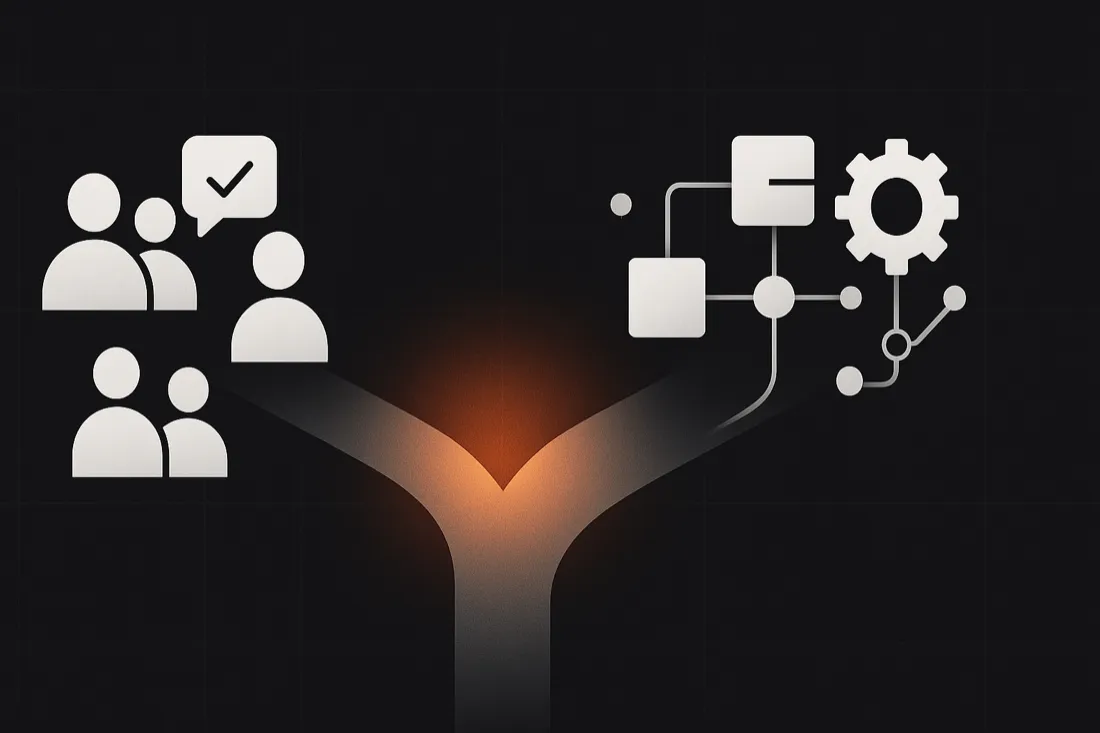
One of the most common questions I get from founders and ops managers at the 10-50 headcount mark: should we hire someone for this, or can we automate it? The question comes up in different forms. “We’re drowning in invoice processing, do we bring on an AP coordinator?” “Our onboarding is falling behind, is that a headcount problem or a tooling problem?” “We spend half a sprint on reporting, should we hire an analyst?”
I worked with an ops team last year that was considering hiring two people to handle a volume spike in client onboarding. Before posting the roles, we mapped the actual workflow. About 70% of the work was sending templated emails, creating accounts in four systems, and updating a spreadsheet. We automated that layer in three weeks. They hired one person to handle the relational parts: first calls, questions, edge cases. That hire had immediate impact because she wasn’t buried in mechanical work from day one.
That’s the decision I want to help you make more deliberately.
Why hire and automate are not interchangeable
The decision to hire or automate is not about technology preference. It’s about understanding what kind of work is actually on the table and what that work requires. Choosing the wrong one creates new problems while leaving the original one unsolved.
Before going through the framework, a quick clarification on what “automation” means here. I’m not talking about replacing strategic roles with bots. I’m talking about structured, repetitive work: data entry, file routing, status emails, report generation, lead assignment, invoice matching. Work that follows consistent rules and runs on predictable inputs.
With that in mind, the decision comes down to three dimensions.
Dimension 1: How often does this task repeat?
Frequency is the first filter. The higher the frequency, the more automation pays off, because every saved minute compounds across every cycle.
Invoice processing might hit your AP team 200 times a month in a busy period. Lead routing in an active sales pipeline might happen 100 times a week. These are high-frequency tasks where automation ROI is clear. (If you want to see the actual numbers for your team, the automation ROI calculator makes it concrete.) A quarterly board report is low-frequency, and unless it pulls from a dozen live data sources, it might not clear the bar.
Dimension 2: Does this task require judgment?
This is the most important filter, and the one that gets ignored most often when teams rush toward automation. Judgment here means: does the right answer change based on context that isn’t captured in a rule? Does someone need to read a situation and make a call?
Approving a vendor payment above a certain threshold requires judgment. Routing an inbound lead to the right sales rep based on company size and vertical follows a rule. Writing a proposal requires judgment. Sending the right onboarding email when a new client row gets added to your CRM follows a rule.
Some tasks that feel like they require judgment actually don’t. They require consistent rule application, but the rules are complex enough that nobody has written them down. Part of the work of automation is surfacing those rules so they can be encoded.
Dimension 3: What happens when something goes wrong?
Automation handles predictable, containable errors well. If an invoice doesn’t match any known vendor, the system can flag it and route it for review. If a lead comes in without a valid email, the system can catch it. Error handling is a design problem, not a blocker.
Automation struggles when the error states are unpredictable, require context the system doesn’t have, or have high consequences if missed. A compliance review, a sensitive client communication, a decision that affects someone’s employment: these are not automation candidates regardless of how frequently they occur.
Applying the framework to real tasks
Invoice processing. High frequency, follows rules (match vendor, check amount, route for approval above threshold), errors are mostly catchable. Automation is the right call. The AP coordinator you were considering can focus on exception handling and vendor relationships instead of data entry.
Lead routing. High frequency, rules-based (company size, geography, vertical, inbound source), errors are low-stakes and correctable. Automation handles this without headcount. A round-robin or attribute-based routing system works well here.
New employee onboarding. Medium frequency, partially rules-based (send offer letter, set up accounts, schedule first-week meetings), partially judgment-based (read the new hire, adjust the pace, handle questions). This is a split. Automate the mechanical steps. Keep a human for the relational parts. You may not need a dedicated onboarding coordinator, but someone needs to own the experience.
Weekly operational reporting. Depends on what “reporting” means. If it’s pulling numbers from three systems and populating a template, that’s automation. If it’s interpreting the numbers and writing commentary for the exec team, that’s judgment work. Often it’s both: automate the data assembly, keep the analyst for the interpretation layer.
When hiring is the clear answer
Automation is not always the answer. Hiring is the right call when:
- The work requires ongoing judgment and context that can’t be encoded in rules
- The role is customer-facing in a way where the human relationship is the product
- The team needs leadership, mentorship, or strategic input, not throughput
- The volume is low enough that building automation costs more than the problem is worth
- The process is still evolving and changes frequently
That last point deserves more emphasis. Automating a process that changes every quarter locks in the wrong version. The right sequence is: document the process, stabilize it, then automate. If you haven’t stabilized it yet, hiring someone to own the process first is often the right move. They’ll surface the ambiguities that automation would otherwise bake in as bugs. This is one of the main reasons automation projects fail despite technically working: the process they encoded wasn’t actually stable.
The trap most founders fall into
The most common mistake I see is treating this as a binary, permanent decision. Teams hire for a role that’s 80% mechanical, then discover the person spends most of their time on work that could have been automated. Or they automate a process that turns out to require more judgment than they realized, and the system fails in ways that are harder to debug than just handling it manually.
The honest answer is that most roles at the 10-50 headcount stage are hybrid. There’s a rules-based layer that can be automated, and a judgment layer that needs a human. The question isn’t whether to hire or automate. It’s which parts of the role can be automated, so the person you hire is doing the highest-leverage work, not the mechanical work.
I’ve seen ops teams go from three people spending most of their week on data movement and status emails, to one person handling exceptions and vendor relationships, after the mechanical layer was automated. That’s not replacing headcount. It’s redirecting it.
How to use this framework
Start by listing the tasks where you feel the capacity crunch. For each one, ask three questions:
- How many times does this happen per week?
- Does it follow a consistent rule, or does it require reading the situation?
- What’s the cost of an error, and is that error catchable by a system?
Tasks that are high-frequency, rules-based, and have catchable errors are automation candidates. Tasks that require ongoing judgment, relationship context, or have high error consequences need a human. Most tasks have both layers. Your job is to separate them before you hire or build.
One more thing worth noting: as AI agents become more capable, the line between rules-based and judgment-based work is shifting. Some tasks that used to require a person can now be handled by an agent that reasons through context rather than following a fixed rule. If you’re curious where that line sits in 2026, the AI agents post covers it in detail.
If you’ve got a list of tasks and aren’t sure which ones qualify, that’s exactly what an operations audit is for. I’ll meet with your team, map your workflows, identify what can be automated versus what needs headcount, and give you a concrete recommendation. Or if you’d rather talk it through first, reach out directly and we can work through it together.
The goal isn’t to automate everything. It’s to make sure the people you do hire are spending their time on work that actually requires them.